Title: Pathetic Fallacy
First Non-Festival Release: TBD
Director: Adam Egypt Mortimer
Writer: Andrew Barrer, Gabriel Ferrari
Runtime: 98 Minutes
Starring: Scott Mescudi, Jessica Rothe, Natasha Lyonne
Where to Watch: Check out where to find it here
This film’s review was written after its screening at the Fantastic Film Festival in 2026.
Love is a powerful motivator for many people. Among many things, it manifests in parents taking on 2-3 jobs to provide for their family, drives kids to scrape off their excess food into their dog’s bowl, and colors every songwriter’s confessions of love to their nameless partners. When a loved one dies, or is close to death, the power and shape of a person’s love determines how they handle their new reality. It’s here in Pathetic Fallacy where Adam Egypt Mortimer works through the messier faculties of love.
Two young lovers, Asher (Scott Mescudi) and Iris (Jessica Rothe), have a pitch perfect romance. Over the years, they have equally weathered challenging fights and embraced the quiet consistency of each other’s devotion. When Iris succumbs to an incurable disease, Asher finds himself adrift. Desperate for direction, Asher is lulled into a nightmarish journey to Mount Samdi, but when he arrives, he finds himself caught into a cosmic trap that threatens his sanity. Lured in by the promise that he can bring Iris back to life, Asher internalizes a new goal: kill seven strangers by his own hand, so her can finally be reunited with her.
A messy treatise on grief and the new realities it creates, Pathetic Fallacy nonetheless delivers stunning, cerebral horror.
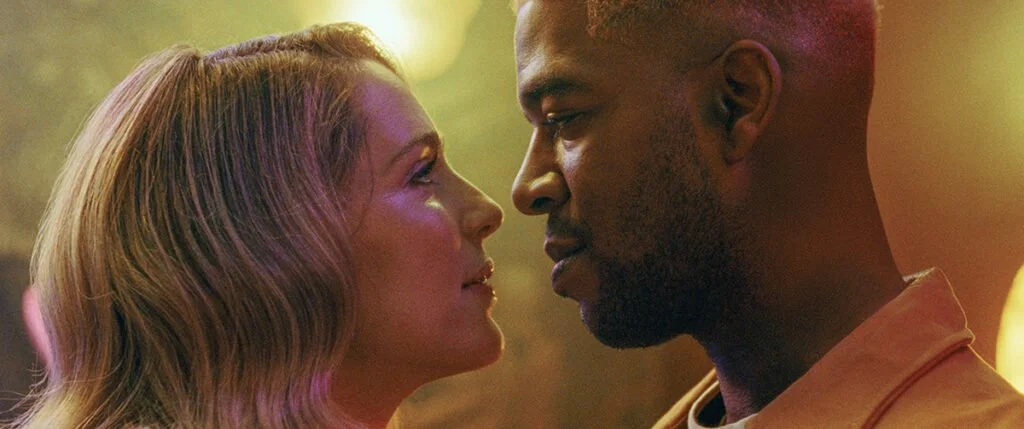
Pathetic Fallacy is easily one of the most unique depictions of grief coming from the 2020s. The first 40 minutes are an absolute whirlwind of grief, stylized music numbers, and the sinking, hopeless feeling of loss, flexing the emotional core of the story while holding its cards close to its chest. Focusing on the tragedy of Asher and Iris’s love story, Pathetic Fallacy asks audiences how to move on from loss. The heartbreaking romance lays the perfect foundation to Asher’s inevitable spiral while also working to introduce the film’s thesis on accepting death.
Not fitting neatly into any one box or convention, Pathetic Fallacy depicts grief as an overwhelming, all-encompassing lifestyle choice rather than a feeling. Driven mad by his desire to see Iris again, Asher’s grief predictably dulls his world. Much of this boils down to Iris and Asher’s perspectives on death. Iris has long accepted that there is no other choice but to embrace the inevitable and only wants comfort in her final moments. Asher still believes if he could do something different, it might change everything for both of them. His characteristic charm and drive in life dims after Iris’s death, leaving him with no choice but to confront the listless darkness within him. Refusing to accept the finality of death, Asher’s choice to fixate on what once was rather than what can be becomes his undoing. It’s in this choice that Pathetic Fallacy begins taking huge swings that will determine whether it works for an audience member or not.
And Pathetic Fallacy does swing hard, making plenty of interesting choices throughout Asher’s journey. Crossing paths with serial killers, demonic talking woodland animals, and a manipulative spider (Natasha Lyonne) that burrows into his head and coaxes him into indulging in violence, Pathetic Fallacy takes a surreal approach to psychological horror. Egged on by the voices of the insidious creatures, Asher is given a choice: either he kills seven innocent people to bring back Iris, or he gives up his quest. Paired with the dream-like musical numbers that push him further into the mystical woods of Mount Samdi, Pathetic Fallacy uses Asher’s desires against him, transforming him into a shell of the man he once was.
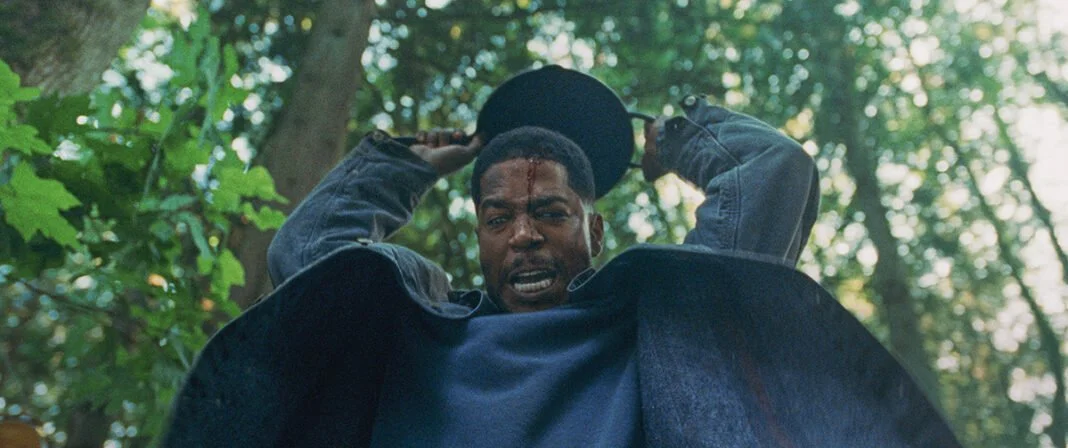
As an audience, we’re asked to question if this is the right choice. If we love someone, as much as we claim, would we not also do whatever it takes to keep them in our lives? Pathetic Fallacy doesn’t judge Asher, or us, for the desire but does demonstrates why this doesn’t help.
This messiness extends to the production behind Pathetic Fallacy as well. Dazzling, unsettling imagery, immaculate set design, and sweeping, picturesque cinematography make the colorful, neon-soaked world come to life. Intentionally chaotic editing, courtesy of Vera Drew, and the bizarre choice to include various talking woodland creatures give Pathetic Fallacy even more edge to it. It’s impossible to deny that the nightmarish hue the film takes on comes together only because of the various conflicting and overlapping elements. It’s furthered by the sonically beautiful soundtrack. Only lacking in terms of lyricism, the choice to integrate musical numbers adds interiority to both Asher and Iris while furthering the film’s complicated themes of death and grief.
By the time it reaches the finale, Pathetic Fallacy does lose some steam. Sagging in the middle, especially with the tense but otherwise limp serial killer-focused segments, director Adam Egypt Mortimer gets lost in his own forest. It compounds with the arrival of a band that catches Asher’s attention in more ways than one. It offers more chances for Mescudi and Rothe to deliver sensational, engaging performances but adds another tonal layer to the film that doesn’t quite work. One final twist makes narrative sense but is a certifiable let-down after investing in Asher’s arc.
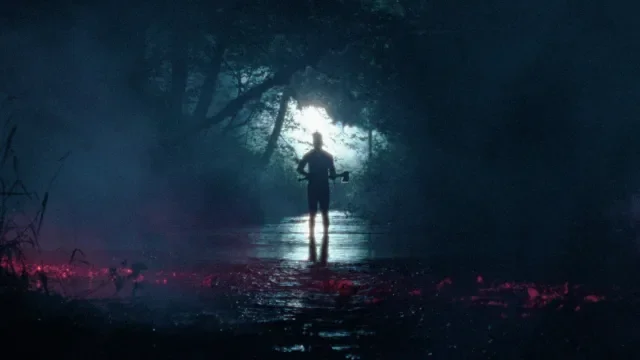
Powerful, beautiful, and all-together impressive from a technical standpoint, Pathetic Fallacy’s attempt to bring further depth to grief horror is uneven in execution. It’s impossible to deny Mortimer’s talent for creating hazy psychological stories but Pathetic Fallacy falls short in maintaining tone and direction with Mortimer’s storytelling. Strong performances, striking imagery, and a nuanced approach to grief make Pathetic Fallacy a must-watch for horror fans, even if it doesn’t quite nail everything in the end. When you, or someone you love, is at the end, do you think you would accept reality or will you find yourself on a journey to Mount Samdi in hopes of staving off the inevitable?
Overall Score? 7/10