South Korean Bio-Shocker Colony (2026) Serves Up Deliciously Gooey Infection Horror
Title: Colony
First Non-Festival Release: May 21, 2026 (Theatrical Release)
Director: Yeon Sang-ho
Writer: Choi Kyu-seok, Yeon Sang-ho
Runtime: 123 Minutes
Starring: Gianna Jun, Koo Kyo-hwan,
Where to Watch: Check out where to find it here
A biotech conference is thrust into chaos when a disgruntled ex-researcher, Young-cheol (Koo Kyo-hwan), unleashes a bio-terror weapon on the unsuspecting conferencegoers. Among the survivors trapped indoors is reviled scientist Dr. Kwon Se-jeong (Gianna Jun), originally there to meet with CEO Kang Woo-chul (Kim Jong-tae) at the behest of her ex-husband Han Gyu-seong (Go Soo). Using her scientific knowledge against the expertise of the remaining survivors, Se-jeong leads the dwindling group through the building’s maze of hallways and various rooms while scientist Gong Seol-hee (Shin Hyun-been), Gyu-seong’s wife, assists the counterterrorism unit outside the building.
Colony is a terrifying and compelling indictment on growing technological fears that never skimps on the gloriously bloody zombie carnage it promises.
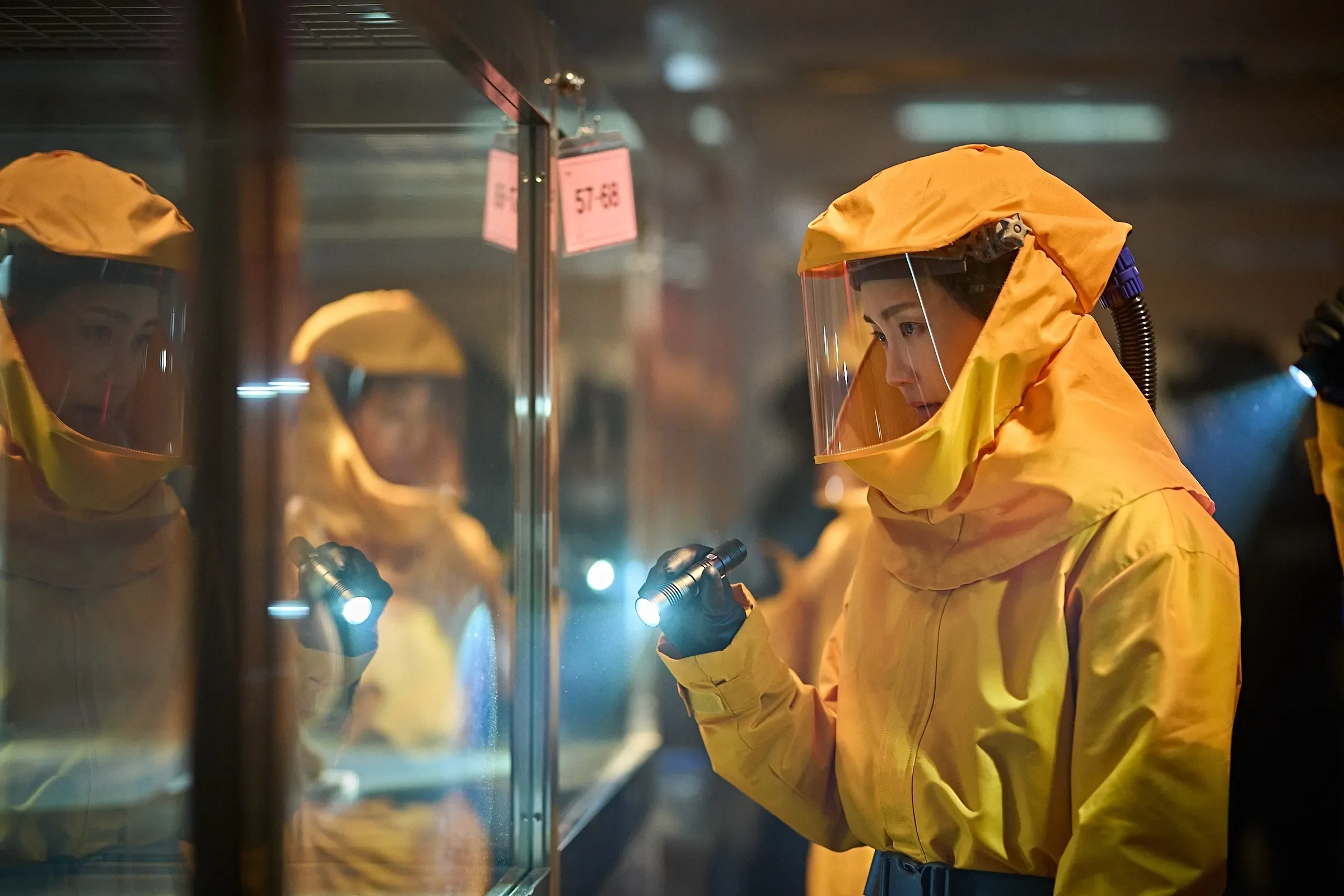
It’s difficult to mine new territory in a zombie film but Colony adds enough to the cannon to deserve commendation. Impossibly fast and suspiciously smart, the zombies in Colony are as vicious as they are adaptable. Evolving in real-time to their surroundings, the zombies sus out their environment in a similar manner the human characters do. Rapidly reproducing through infection and amplifying its reach through the knowledge and power of its hosts, the fungal virus is a true force of nature despite its manmade origins. Alone, they are terrifying in their own right. Together, however, they create a vast network of braindead spies that help make their end goal of converting all of humanity that much easier.
Zombie and infection films are often used as vehicles to depict greater humanity and critique various elements of society. In Colony, the newly infected’s affliction offers them a special kind of hive mind ability that, in its form, correlates to many current societal woes. Fears of the impending hostile takeover of artificial intelligence upon industry and concerns of the implication of too much connection in the form of social media are present in Colony but so is an underrated issue: mass surveillance.
With the hive mind able to communicate throughout the 30-story company building, the calculus involved with escaping and retrieving valuable public health information becomes much more challenging than it would be in a simpler living dead film. Every move of the survivors can be watched between the massive CCTV network within the building and the scores of infected scouring the halls. With the plot hinging on his abduction/evacuation and his personal connection to the infected, Young-cheol sics his army of braindead husks to attack the remaining survivors by sniffing out clues to his location and broadcasting them to his zombie network. As the group winnows, their desire to cooperate strains, allowing Young-cheol precious time and resources to further his body count.

The fears of surveillance are palpable especially when its benefits only go so far. Used as an avenue to track and locate their one chance of survival, Young-cheol, both the survivors inside the building and scientists outside use cameras to their benefit. Unfortunately for all groups, the technology is easily used against them through social engineering. Never knowing who is reading their text messages or listening to their conversations nearby, the zombie film adds an extra layer of danger to technology that is often described as a savior in horror film settings. It raises questions that are necessary across cultures.
Do the benefits of Siri outweigh the fact that it listens to every word a user says? If Flock cameras are so beneficial to solving missing person cases and homicides, why are they being used to track cop’s ex-girlfriends and catch people crossing state lines for legal cannabis? These problems aren’t local to any country but are worldwide concerns for privacy, safety, and autonomy.
What separates Colony from other similarly minded films is its approach to characters. While many zombie and infection films use the inciting incident to sew initial distrust and fear, Colony sees its core group of survivors cooperating readily. The typical “humans are the real monsters” trope seems to infect the sub-genre more often than not but thankfully not here. Of course, there is some pushback, and mistakes are made but the willingness the survivors have to work together and lean on each other’s expertise makes Colony feel fresh. This isn’t to say that there are no human adversaries or conflict in Colony, but that it is better integrated.

Nothing illustrates this more than Se-jeong and Seol-hee’s arcs. Initially predicting tension with their awkward introduction, Colony forces the two to work together well before any half-baked rivalry can be established between them. There’s a certain chilliness, for sure, but Colony is careful to side-step typical sexist storylines that seek to paint women as competitors rather than collaborators. With more reason to gain from working in tandem, Colony demonstrates the utility of cooperation beyond doing what is right for right’s sake. Young-cheol’s power grab works to foil their journey. Fitting perfectly within Colony’s greater thesis on humanity. These two perspectives help reframe cooperation as a necessity rather than a mere nicety.
Despite its extensive character work and world building, the true star of Colony is its relentless pace and breathless action sequences. Kickstarting the mayhem relatively soon, compared to similar infection-based horrors, Colony has its work cut out for it by gambling on an early start. It pays off, as the inaugural massacre establishes the film’s tone and sense of danger with ease. From there, each escalation is paired well with a developmentally appropriate escape plan and a suitably tense face off against the rabid flesh puppets. All choices are earned, as is every emotion that flares from the rapidly shrinking cast of characters. Colony ensures its action never stagnates, both in terms of physical and narrative weight.
A slick, action-packed infection horror, Colony proves there is still more to uncover through the zombie apocalypse. Balancing compelling commentary on the rapid acceleration of technology (without a solid ethical foundation) against its sick-ass zombie fight sequences and great understanding of escalating stakes makes Colony a no brainer to recommend to any kind of horror fan.
Overall Score? 8/10