The Horrors of White Guilt Abound in Jollyface (FANTASTIC), a Slasher Primed for Controversy
Title: Jollyface
First Non-Festival Release: TBD
Director: Justin Floyd
Writer: Justin Floyd
Runtime: 77 Minutes
Starring: Emily Kimball, Kofi Siriboe, Alexis Louder
Where to Watch: Check out where to find it here
This film’s review was written after its screening at the Fantastic Film Festival in 2026.
Racial politics in the United States have long inflamed resentment in the country. By no fault of their own, Black people and other people of color are forced to fight for the right to a dignified life. For many progressive white people, there is a desire to be an agent for positive change. Oftentimes, however, their unchecked biases and propensity for reactionary measures leads them to doing or saying things that are unhelpful at best and dangerous at worst.
This is the situation that Blair (Emily Kimball) has found herself in following the unexpected shooting death of her Black boyfriend, Nick (Kofi Siriboe). The investigation determines he was killed by a Black man, which confuses Blair causing her to investigate further, since the police are virtually useless at that point. Even her friend, Charlotte (Alexis Louder), a Black police officer isn’t immune to her misplaced ire. When Blair gets too close to the truth, she is introduced to Jollyface (Jacob Bridges), a white serial killer wearing blackface to sow confusion and division. Now that Blair is aware of the truth, she, and all those she cares about, must be punished.
A messy, well-intentioned slasher, Jollyface delivers sharp tension and muddled messaging.
Jollyface is practically designed in a lab to ignite controversy. Focusing its narrative on white saviorism and the ways in which white people center and insert themselves in racial discourse, Jollyface critiques the ignorance, even if it is well-intentioned. Characterized as a loving girlfriend who may be a bit too excited to be “one of the good ones,” Blair puts herself and the Black people in her life in danger by inflaming racists. Nothing demonstrates this more clearly than the beginning of the film when she insists that Nick confront a white man staring at them. When Nick walks over, he quickly realizes he is blind. While this interaction is innocuous on the surface, it puts the onus on Nick to stand up for their interracial relationship even if it potentially places him in a bad situation.
The savior mentality doesn’t go away even after Nick is murdered. Blair pours her heart into solving the murder, blatantly ignoring the more even-keeled advice and information from those around her. Despite being told over the phone by police that she will have an opportunity to review the footage of the murder on the condition she keep it private for the active investigation, she immediately goes to social media to update them. When she asks Charlotte to show it to her instead, she is given a resounding no, as it would likely put Charlotte’s job at risk for nothing. Blair’s answer is to invent a ruse to draw Charlotte out, so she can sneak in and take her laptop herself.
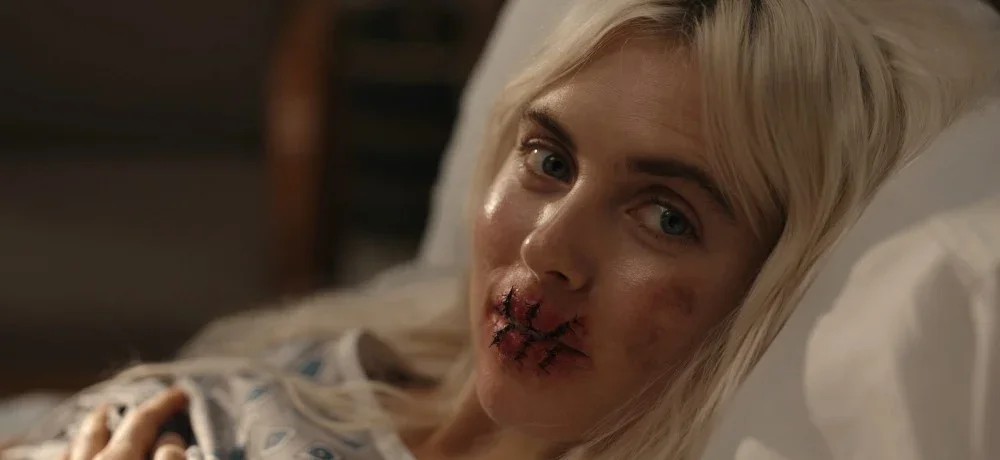
It’s this pattern of willful disregard for Black people’s safety and justice to unburden her own feelings that becomes Blair’s downfall, as well as the innocents in her wake. It’s frustrating but it does further the thesis of the film and makes Blair a fascinating character, and sadly a relatable one to any Black person. While the killer physically dons blackface, director Justin Floyd, argues that Blair does so emotionally, something he shared in the subsequent Q&A. It’s a compelling nugget of information that sadly doesn’t fully come together in the end.
Understandable to a point but irritating nonetheless, the characters of color feel sidelined in Jollyface to the point where it feels reductive. While Jollyface does focus on dissecting whiteness, it doesn’t give its characters of color the same consideration or screentime. Charlotte is severely underwritten, almost embodying a sacrificial Black woman role in the film, and Nick is only present in Blair’s relentless quest for justice. But is it for Nick or Blair? The cartoonish handling of white people’s racism, while certainly present in real life, doesn’t match the dark, downbeat tone of the film. In the end, its messy handling of the material dilutes the message, and the stylish direction gives it an almost otherworldly feeling, making it feel disconnected with reality at times.
Beyond its story, Jollyface does deliver in terms of horror. The modest apartment complex exudes darkness and claustrophobia, giving a nice feeling of isolation in a city setting. The paranoia Blair feels following Nick’s murder is stretched to extremes that feel heartbreakingly real for anyone unfortunate enough to be in her situation. Well-executed scares and intense chase scenes give the Jollyface killer edge and make the horror feel personal.
Divisive, for sure, yet effective, Jollyface is certain to stoke important conversations as much as it does terror in the hearts of anyone watching. The terrifying concept works well enough, even if the film’s messaging gets muddled and lost in unfortunate character choices that certainly do not help. Solid performances and production values make it a serviceable film by the end. If nuanced attempts at deconstructing American racial politics mixed with a terrifying killer excites you, put Jollyface on your radar.
Overall Score? 6/10