Title: Teenage Sex and Death at Camp Miasma
First Non-Festival Release: August 7, 2026 (Theatrical Release)
Director: Jane Schoenbrun
Writer: Jane Schoenbrun
Runtime: 112 Minutes
Starring: Hannah Einbinder, Gillian Anderson, Jack Haven, Jasmin Savoy Brown
Where to Watch: Check out where to find it here
The need to pathologize and intellectualize everything is suffocating Gen Z. Some discourse leads to genuinely positive understandings of consent, bodily autonomy, and healthy relationships, but there is a point where it goes too far. Puritanical witch hunts over sexual morality have left young people starving for physical intimacy to the point where engaging in sex is scarier than being face-to-face with a killer. Sexuality is not only perfectly healthy, it is part of what makes us human. Writer/director Jane Schonebrun understands this, especially its intersection with film.
On the heels of her Sundance premiering arthouse slasher, up-and-coming director Kris (Hannah Einbinder) is given the responsibility of rebooting the infamous Camp Miasma franchise. A slasher series set at the infamous summer camp, Kris is hellbent on getting the original final girl onboard for the project. Billy (Gillian Anderson) left the industry shortly after the first film but curiously accepted Kris’s invitation to discuss a reprise. The pair spend time getting to know each other while they both share how the series impacted their lives. As lines begin to blur between fantasy and reality, desire and repression, and commercialism and free expression, the embodiment of the franchise, Little Death (Jack Haven), emerges from a hole in the bottom of the lake determined to write the next entry.
A stellar, singular vision of sex and horror, Teenage Sex and Death at Camp Miasma is equally thoughtful as it is fun.
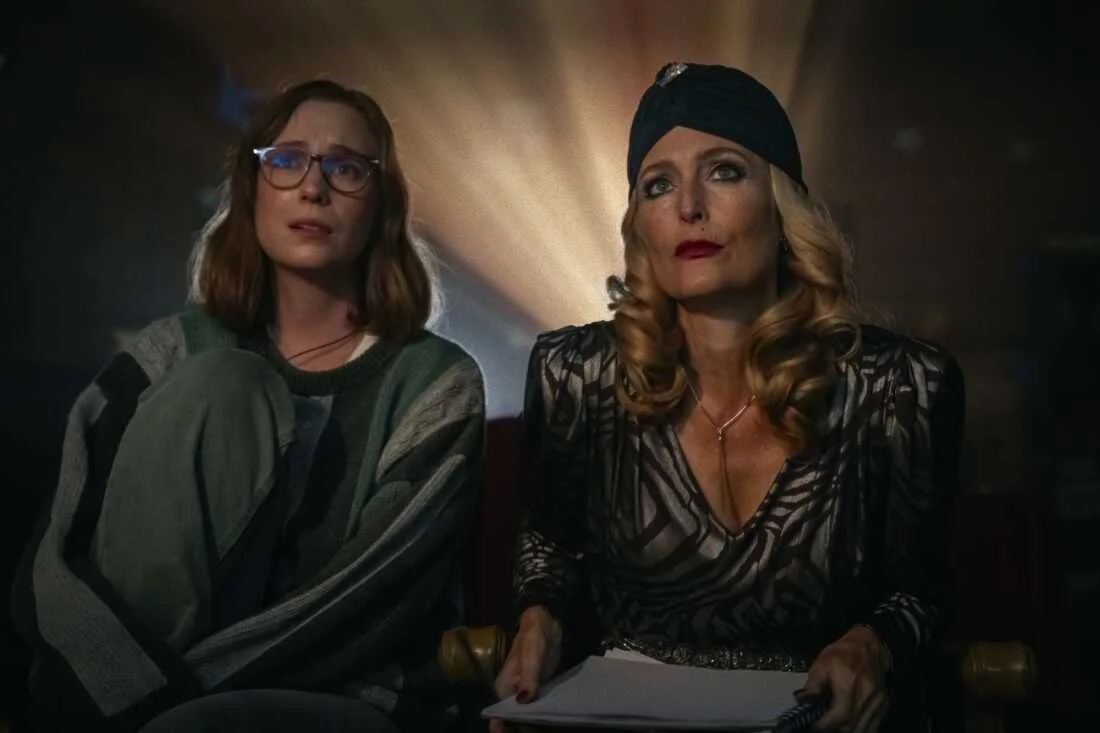
Opining on many of the same things Schoenbrun has made a name for themselves exploring like the ways in which nostalgia intersects with reality and how media can influence our most intimate moments, Teenage Sex and Death at Camp Miasma issues a takedown on Gen Z Puritanism and over-reliance on a specific kind of righteous intellectualism. Kris is introduced as a shy, introverted wonk, obsessed with the technicalities and history of the genre more than the feelings it’s meant to evoke. Her research-oriented, five-dollar word perspective clouds her judgment when trying to revive the series. Stuck with trying to crack the origin story in a way that satisfies her team of uninspiring movie execs while trying to include Billy leads to her own odyssey of sexual exploration.
Kris clashes, subtly, with Billy throughout Teenage Sex and Death at Camp Miasma but never for the wrong reasons. Billy believes in a more authentic, simpler approach to horror. To her, the spark of the series is so intertwined with her own sexual history that it inspires visceral responses. Cannabis-inspired conversations push Kris closer to understanding Billy’s thesis while pushing her out of her comfort zone. Kris finds the experience revelatory, something that demands to be understood in its primal form.
And this is where Teenage Sex and Death at Camp Miasma shines. Self-autobiographical for sure, Kris’s story goes beyond Schonebrun’s own life experience. Billy’s perspective may feel foreign to younger audiences who don’t understand the evolution of sex onscreen through the decades, but it provides a powerful commentary on the ways we sand down the edges of what’s uncomfortable to offer sanitized depictions of human expression.

Its candy-coated approach to meta-horror allows Teenage Sex and Death at Camp Miasma to embody a richer perspective on the slasher genre that simultaneously goes beyond its conventions and embraces them. The push-pull between the disinterest and active misunderstanding of her professional support team and Billy’s embrace of Kris’s journey makes for some compelling commentary on modern visual depictions of sex. Slashers have a history of being reduced to their conventions while simultaneously shouldering the burden of holding insight on society at large during their development and distribution.
In Teenage Sex and Death at Camp Miasma the actual films described are manifestations brought on by the power of the story itself. No matter how many times series antagonist Little Death is cast to the bottom of the lake, he returns with the same commitment to viscera. Regenerative by nature, the Camp Miasma films showcase evolution through trends while essentially sticking to its tried-and-true formula. There’s both comfort and joy in something familiar even if it isn’t breaking barriers or delivering keen insight. Sure, sometimes it feels a tad reductive – boiling down slasher films to just flesh and fluids feels provocative without authenticity – but the ideas that Schoenbrun plays around with are too compelling to ignore.
Both Hannah Einbinder and Gillian Anderson are each captivating in their own right but together make nearly all elements work here. Einbinder’s vulnerable performance gives credence to Kris’s neuroticism in the first half before embracing the full range of emotions the character has been repressing. Conversely, Anderson commands the screen. Her sultry drawl and butter smooth delivery establishes Billy as a woman who has fully lived life. Together, they become a near unstoppable force of glee and sensuality, further bolstering the film’s thesis.

In the end, the weakest aspect of Teenage Sex and Death at Camp Miasma is its slasher elements, ironically. Thanks to its meta narrative, the scares are confined mostly to old film reels and a hallucinatory climax that never fully reveals exactly what happens. This tiptoeing around the fluids portion of ‘Flesh and Fluids’ runs dry as cgi geysers of blood and hack-and-slash massacre sequences give off a more celebratory undertone than fear-inducing. Likely borne from its go-with-the-flow approach to horror, the deaths of its cinematic and imagined victims fit neatly within the story but fail to arouse much in terms of actual thrills.
Not everyone will be on Schoenbrun’s wavelength here, but for those that are, Teenage Sex and Death at Camp Miasma is a bloody sugar high worth chasing. Two electrifying lead performances take an already fascinating script to realization. The execution is largely there, even if it lacks the slasher bonafides one might expect. Indulgent, emotionally resonant, and unapologetic in its singularity, Teenage Sex and Death at Camp Miasma cannot be contained nor should it.
Overall Score? 8/10